Artificial Intelligence and Quantum Artificial Intelligence
Quantum Artificial Intelligence (Quantum AI) is the fusion of quantum computing and artificial intelligence— using the principles of quantum mechanics to design algorithms and models that can outperform or enhance classical AI systems.
Quantum Artificial Intelligence (Quantum AI) is a rapidly developing field that combines the principles of quantum computing with artificial intelligence (AI) to address complex computational challenges that are beyond the capabilities of classical computers and traditional AI techniques.
The Basics of Artificial Intelligence and Quantum Artificial Intelligence
Core principles
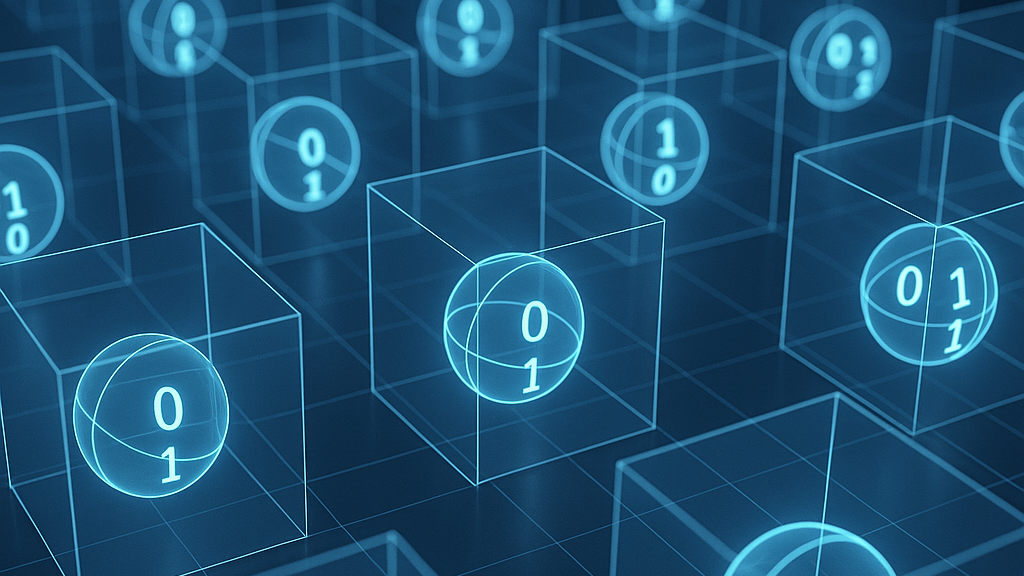
- Quantum Computing: Utilizes the phenomena of superposition (qubits can represent 0, 1, or both simultaneously) and entanglement (qubits are correlated even when separated) to perform computations in parallel, potentially solving certain problems exponentially faster than classical computers.
- Artificial Intelligence: Involves algorithms and models that enable computers to learn from data, recognize patterns, make decisions, and interact with humans.
Returning to the basic qubit quantum mechanics gives us three key tools:
- Superposition – Qubits can represent multiple states at once, enabling massively parallel computation.
- Entanglement – Qubits can be linked so that changes to one qubit affect another qubit instantly, allowing complex correlations to be encoded directly.
- Quantum interference – Amplifies correct solutions and cancels out wrong ones during computation.
When applied to AI:
- Training models can be accelerated by evaluating many possible weight configurations simultaneously.
- Optimization problems (e.g., routing, resource allocation, portfolio optimization) can be solved more efficiently.
- Probabilistic reasoning can be done natively, since quantum states are inherently probabilistic.
Quantum AI approaches:
- Quantum Machine Learning (QML) – Adapting algorithms like Support Vector Machines, k-means clustering, or neural networks to run on quantum processors.
- Hybrid Quantum–Classical Models – A classical computer handles preprocessing and postprocessing, while the quantum processor handles the “hard part” (such as solving a large optimization step).
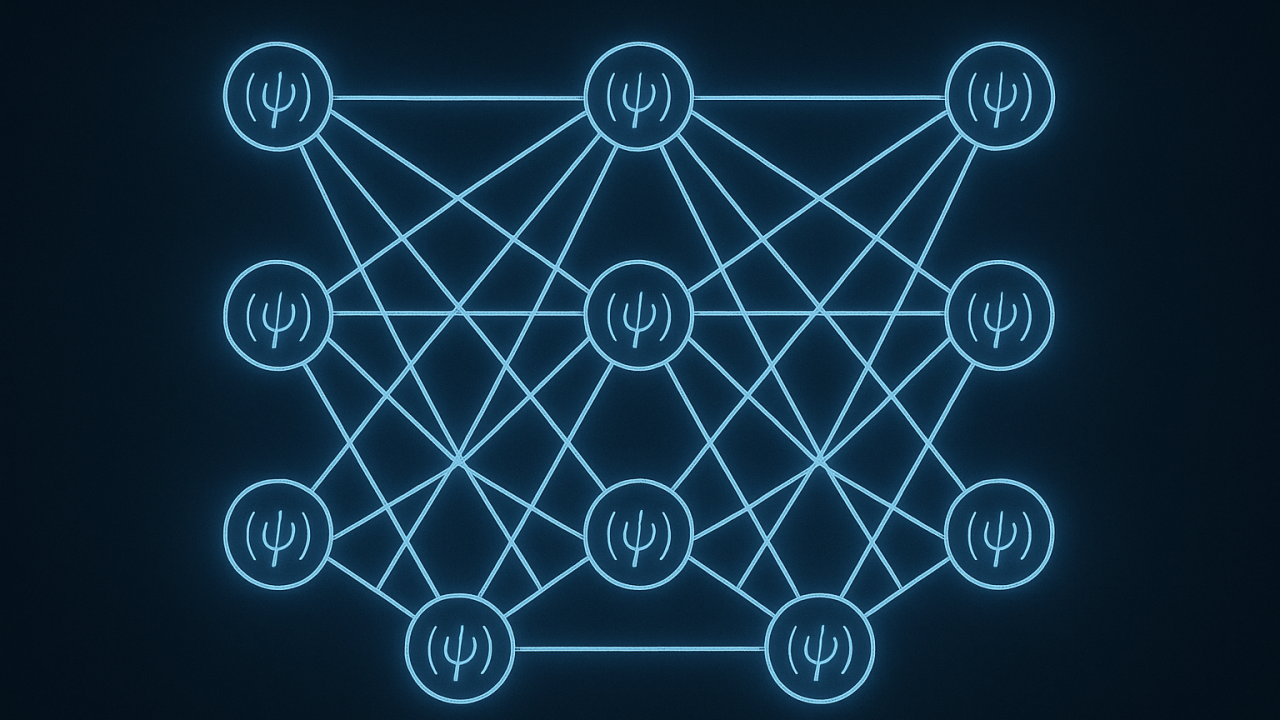
- Quantum Neural Networks (QNNs) – Neural network architectures where qubits and quantum gates replace or augment classical neurons.
Challenges:
- Hardware limitations – Current quantum computers (NISQ era: Noisy Intermediate-Scale Quantum) have too few and too noisy qubits for large-scale AI.
- Algorithm maturity – Quantum AI algorithms are still in the early stages; many are theoretical or only tested on small datasets.
- Error correction – Quantum error correction is essential for reliable large-scale computation, but it’s resource-heavy.
The Potential Benefits
Quantum AI has the potential to accelerate machine learning, enhance optimization, improve data processing, and overcome classical limitations in areas like drug discovery and climate modeling. It could also lead to deeper natural language understanding and increase security. Additionally, quantum models may require less energy compared to classical models.
Current State and Future Outlook
We now step into the “Bleeding Edge” of quantum computing and AI. Much of what we talk about here is a projection of the possible. What actually happens may diverge from what we say in this article.
Quantum AI is still in its early stages due to challenges with hardware stability and error correction. Current efforts focus on hybrid quantum-classical approaches. Major companies like Google and IBM are investing in this area, with significant breakthroughs expected that could redefine industries.
Applications across industries
Quantum AI can be applied across various sectors, including healthcare for drug discovery and diagnostics, finance for portfolio optimization and fraud detection, logistics for supply chain management, and materials science for simulating new materials. It also has applications in security, particularly in developing quantum-safe cryptography.
- Drug discovery & materials science – Faster molecular simulation and property prediction.
- Finance – Portfolio optimization and risk analysis using quantum-enhanced optimization.
- Natural language processing – Potential for more compact and expressive representation of meaning and context.
- Logistics & planning – Optimizing delivery routes or supply chains.
- Cybersecurity – AI-driven quantum algorithms for encryption and anomaly detection.
Challenges and Considerations
Challenges in Quantum AI include the technical maturity of hardware and software, high costs, difficulties integrating with existing systems, and ethical considerations like job displacement and bias. Demonstrating a clear “quantum advantage” is also an ongoing challenge.
- Hardware limitations – Current quantum computers (NISQ era: Noisy Intermediate-Scale Quantum) have too few and too noisy qubits for large-scale AI.
- Algorithm maturity – Quantum AI algorithms are still in the early stages; many are theoretical or only tested on small datasets.
- Error correction – Quantum error correction is essential for reliable large-scale computation, but it’s resource-heavy.
Outlook
Achieving the full potential of Quantum AI requires significant ongoing research and development.
In the near term (next 5–10 years):
- Expect hybrid systems where classical AI is enhanced by specialized quantum routines.
- Quantum advantages in AI will first appear in niche high-value areas like chemistry simulations and optimization, rather than general-purpose AI.
In the long term:
- Once large-scale fault-tolerant quantum computers exist, truly quantum-native AI could emerge, enabling entirely new learning paradigms not possible classically.
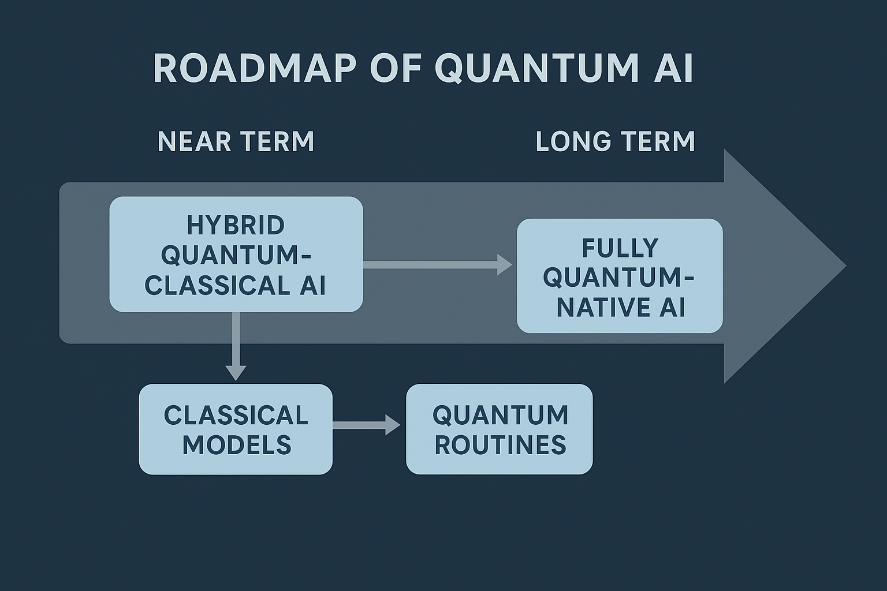
Hybrid Quantum-Classical AI or Fully Quantum-Native AI
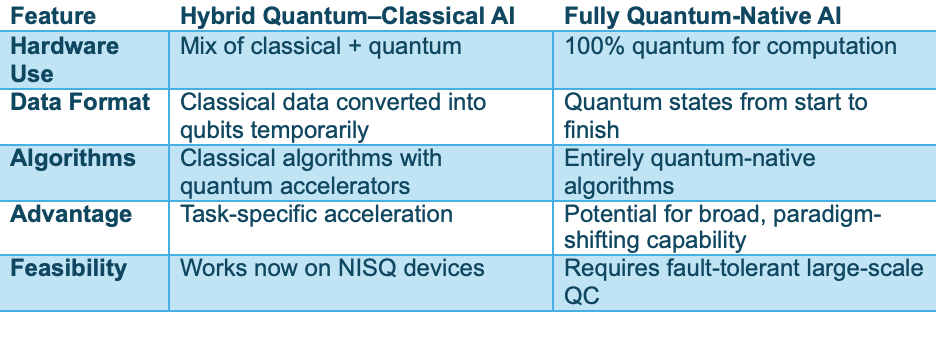
In this section, we aim to get a clear breakdown of the differences between Hybrid Quantum–Classical AI and Fully Quantum-Native AI — both in architecture and capability:
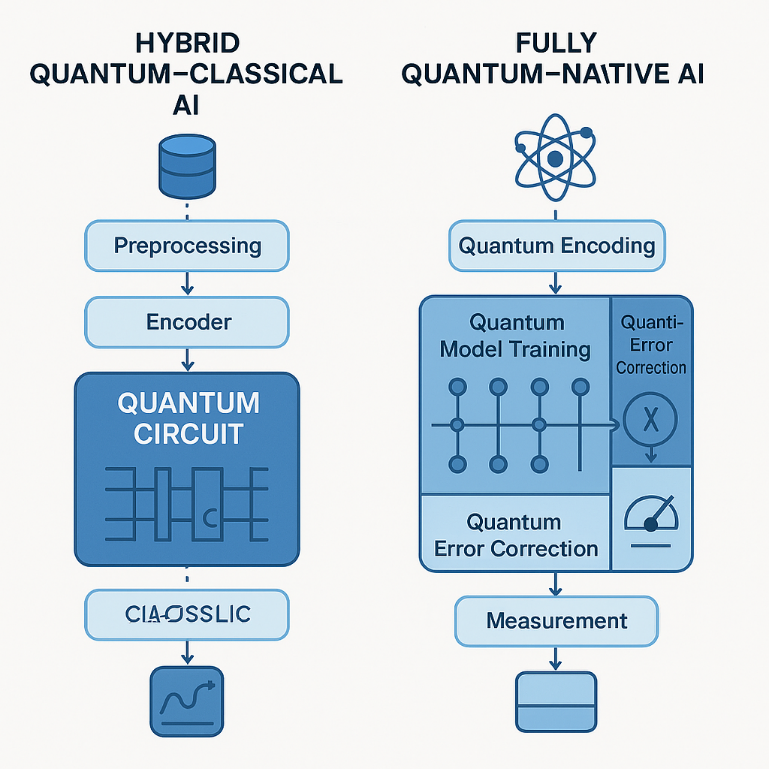
Comparing Hybrid Quantum Classical and Fully Quantum Native AI
Hybrid Quantum–Classical AI (Near-Term)
Definition: A system where quantum computers handle specific sub-tasks inside a mostly classical AI workflow.
How it works:
- Classical computer: does most of the work: data preprocessing, feature extraction, and postprocessing.
- Quantum processor: used for specialized tasks such as:Solving hard optimization problems (e.g., weight tuning in a model).Performing kernel transformations for classification.Running quantum sampling routines.
- The data is passed back and forth between the classical and quantum parts.
Strengths:
- Can work with today’s noisy, small-scale quantum hardware.
- Gains partial speedup for certain bottleneck steps.
- Can be easier to integrate with existing AI models and infrastructure.
Limitations:
- Still bound by classical bottlenecks.
- Quantum advantage is task-specific, not universal.
- Data conversion between classical bits and qubits can be slow and noisy.
Example: A hybrid quantum neural network where the input and most hidden layers are classical, but one quantum circuit layer learns complex transformations that are hard to model classically.
Challenges:
- Integration complexity: Seamlessly combining classical and quantum components requires sophisticated hardware and software systems.
- Quantum hardware limitations: Current quantum processors still face limitations in qubit count and coherence times.
- Developing efficient algorithms: Creating algorithms that effectively leverage the strengths of both classical and quantum computing can be complex.
Fully Quantum-Native AI (Long-Term)
Definition: An AI system where the entire architecture, learning process, and data representation are quantum — no classical intermediary is required for core computations.
How it works:
- Data is stored in quantum states from the start (e.g., quantum sensors or quantum-generated datasets).
- All learning steps — feature encoding, model training, inference — happen inside a quantum circuit.
- Uses quantum-native representations of data that classical computers cannot directly simulate.
Strengths:
- Potential for exponential speedups for certain classes of problems.
- Can explore solution spaces inherently inaccessible to classical models.
- Models can exploit quantum correlations (entanglement) as part of their reasoning process.
Limitations:
- Requires large-scale, fault-tolerant quantum computers — not available yet.
- Needs entirely new quantum-native AI algorithms, not just adaptations of classical ones.
- Challenging to design and debug, since there’s no easy classical simulation.
Example: A quantum-native generative model that creates new molecular structures by evolving entangled qubit states directly, without ever converting them into classical data until the very end.
Challenges:
- Hardware limitations: Building large-scale, fault-tolerant quantum computers with enough stable qubits for complex AI applications remains a significant hurdle.
- High error rates: Quantum computers are highly susceptible to noise and decoherence, leading to errors that are difficult to correct.
- Algorithm development: Developing entirely new quantum algorithms tailored for AI tasks is a complex and ongoing research area.
- Costs and accessibility: The infrastructure required for fully quantum-native AI is currently very expensive and inaccessible to most.
Key Differences in a Nutshell