Quantum Mechanics Applied to Quantum Computing – Quantum Chips
Quantum Mechanics Applied to Quantum Computing
Quantum computing chips are specialized processors designed for quantum computers, utilizing qubits. This capability allows quantum chips to tackle complex problems beyond the reach of classical computers. Several companies are actively developing these chips, including IBM, Google, Intel, Rigetti, and Xanadu, each employing different qubit technologies like superconducting, trapped ions, or photonic approaches.
Types of Qubits & Quantum Processors:
Different approaches and designs are being explored, including superconducting qubits (e.g., IBM), trapped ions (e.g., IonQ), photonic qubits (e.g., Xanadu), and silicon-based qubits (e.g., Intel). Exploring these different technologies will help us to understand the many different approaches to the very complex development of quantum computers. First up, a quick survey of the major QC developers.
Major Companies Developing Quantum Computing Chips:
- IBM:
IBM is well-known for its superconducting qubit technology and the “Eagle” processor, which features 127 qubits. They have created the acronym CLOPS, or circuit layer operations per second. Eagle is based on the Josephson junction, or gaps in the superconducting circuits acting as non-linear inductors. - Google:
Google is focusing on superconducting qubits and recently introduced the “Willow” chip, notable for its error correction capabilities. Willow QP is based on superconducting Transmon Qubits. This qubit is achieved by using a Josephson junction shunted by a large capacitor. This design allows for a more stable and controllable quantum states. - Intel:
Intel is investing in silicon-based quantum processors using silicon spin qubits. Tunnel Falls is Intel’s advanced silicon spin qubit chip. Tunnel Falls utilizes electrons held within silicon as qubits, where the “spin” of the electron (up or down) represents the quantum bit of information. - Rigetti:
Rigetti develops and offers cloud-based quantum computing services using superconducting qubits. Rigetti is producing the Novera QPU, a 9-qubit processor and their Ankaa-3 system of 84 qubits. The designs are based on superconducting Josephson junction circuits, which are designed to behave as quantum bits. - Xanadu:
Xanadu specializes in photonic quantum computing and introduced a design named Aurora, utilizing light to perform computations. Xanadu’s qubit is photon based. - PsiQuantum:
PsiQuantum aims to build a large-scale quantum computer with a million qubits based on photonictechnology. Two multi-million Qubit facilities in Brisbane, Australia and Chicago, Illinois, are currently under construction. - QuantWare:
QuantWare focuses on superconducting quantum processors utilizing a 3D chip architecture. Their qubit incorporates superconducting qubits based on ferromagnetic Josephson junctions. Their Soprano-D is a 5 qubit QPU. - Microsoft:
Microsoft introduced the “Majorana 1” chip based on topological qubits and a new type of material called a topoconductor. These topoconductors create Majorana Zero Modes (MZMs). This topological superconducting state gives rise to Majorana Zero Modes (MZMs). MZMs are exotic quasiparticles that appear at the ends of topological superconducting nanowires within the topoconductor. In Microsoft’s design, each qubit is formed by a structure resembling an “H” shape made of aluminum nanowires, with four controllable MZMs, two at each end of the “H”. The presence or absence of an unpaired electron, shared between these two MZMs, represents the quantum state (0 or 1) of the qubit. - Diraq:
Diraq specializes in building silicon-based quantum computers and aims to integrate billions of qubits on a single chip. Diraq qubits are based on silicon quantum dots. Specifically, they utilize the spin of electrons within these quantum dots to represent quantum information. This approach leverages the existing Complementary Metal-Oxide-Semiconductor (CMOS) manufacturing infrastructure.
Challenges and Future Directions:
- Scalability:
Increasing the number of qubits on a single chip while maintaining coherence and accuracy remains a major challenge. - Error Correction:
Quantum computations are susceptible to errors, and developing effective error correction techniques is crucial. We have discussed error correction and fault tolerance in previous editions of “The Bleeding Edge”. - Cost:
Quantum computing chips are currently very expensive to manufacture, and reducing costs is essential for wider adoption. The most ambitious quantum computer companies are scaling to multi-million qubit computer systems housed in large buildings. One example are PsiQuantum’s current construction projects. - Applications:
We have noted the applications of quantum computers in our previous “The Bleeding Edge” newsletter articles. As we have indicated, quantum computers are still in the early stages of development, and identifying and developing practical applications for them is an ongoing effort.
Quantum computing is a rapidly evolving field, and the development of more powerful and scalable quantum chips is crucial for realizing the full potential of this revolutionary technology. The error rate that is required is parts in 106 to 1011. That is 1 in 1,000,000 (1 million) to 1 in 100,000,000,000 (100 billion) to accomplish their goal. See our prior “The Bleeding Edge” newsletter article for information on error rate and fault tolerance.
We review below a photonic quantum computer developer and their effort to develop a semiconductor architecture to better understand one company’s approach to a photonic qubit. All information is from their public facing website and papers released through various publication websites.
PsiQuantum – Photonic Quantum Computer Realized
Based on my discussions on the quantum mechanics of photons I present one company’s development of a photonic quantum computer. This is natural progression to the physical embodiment of our photonic quantum mechanical to qubit discussion. On their website PsiQuantum states, “In 2016, PsiQuantum founders uncovered a viable path to build large-scale, fault-tolerant systems by taking a photonics approach and leveraging the advanced semiconductor manufacturing industry and other existing infrastructure. Nearly nine years later, PsiQuantum is building thousands of wafers of quantum chips, testing production cryogenic cabinets and developing fault-tolerant algorithms to deploy on our first systems.”
The PsiQuantum website introduced “Omega, a manufacturable chipset designed for utility-scale, million-qubit quantum computers. Featured in a paper published in Nature, the chipset integrates advanced components, including high-performance single-photon switches, into a high-volume semiconductor manufacturing process at GlobalFoundries.”
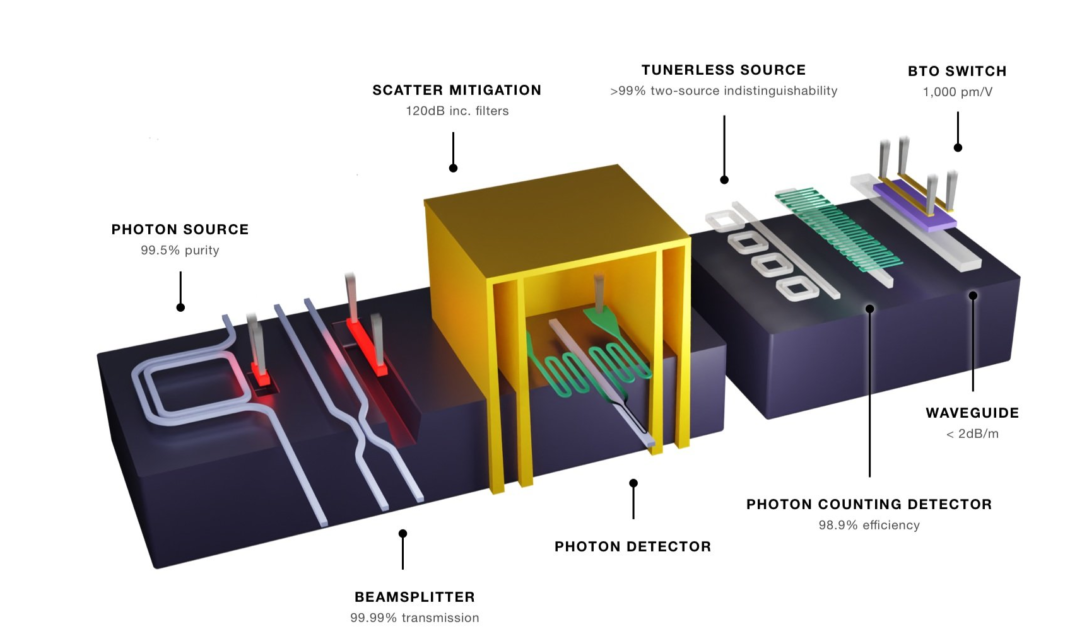
https://www.psiquantum.com/research
“Omega achieves 99.98% single-qubit state preparation fidelity, 99.5% two-photon quantum interference visibility, 99.72% chip-to-chip quantum interconnect fidelity, and 99.22% two-qubit fusion gate fidelity, setting new benchmarks for photonic quantum computing.”
“PsiQuantum’s approach focuses on fusion-based quantum computing (FBQC), which uses single photons as qubits and integrates them into scalable systems via optical fibers. The company has demonstrated high-fidelity quantum interconnects over distances up to 250 meters, a critical step toward building large-scale, fault-tolerant quantum systems.” https://www.psiquantum.com/blueprint
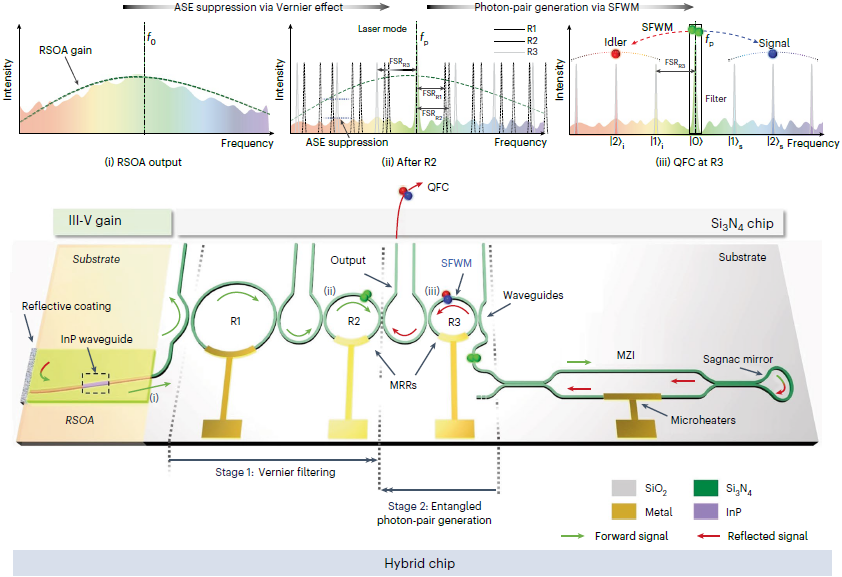
Full on-chip photonic turnkey quantum source for entangled qubit/qubit state generation.
From their article: “An electrically pumped InP III–V reflective semiconductor optical amplifier (RSOA) providing optical gain is coupled to a Si3N4 chip containing a three-micro-ring (R1, R2 and R3) Vernier filter and a Mach–Zehnder interferometer (MZI) with a Sagnac (loop) mirror. The free spectral ranges (FSRs) of R1, R2 and R3 are ~107 GHz, ~167 GHz and ~199 GHz, respectively. The spectral positions of the ring resonances can be adjusted using electrically driven integrated microheaters to provide a single frequency filter in the gain bandwidth via the Vernier effect. Together with the gain section and the cavity built by the end mirror and loop mirror, the system allows laser operation on this filter line. The backward-propagating laser field acts as the excitation signal for a spontaneous four-wave mixing (SFWM) process within the third ring, R3, producing a quantum frequency conversion (QFC). Spontaneous four-wave mixing (SFWM) is a third-order nonlinear optical process where two photons from a pump field are converted into two photons with different frequencies. This process is often used to generate correlated or entangled photon pairs, making it a valuable tool in quantum optics and technology.”
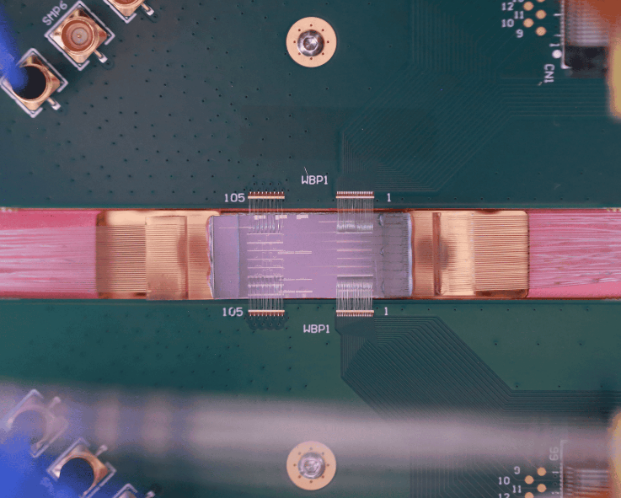
PsiQuantum Optical Qubit chip is pictured here in the two following pictures. The first is a picture that implements the designs above.
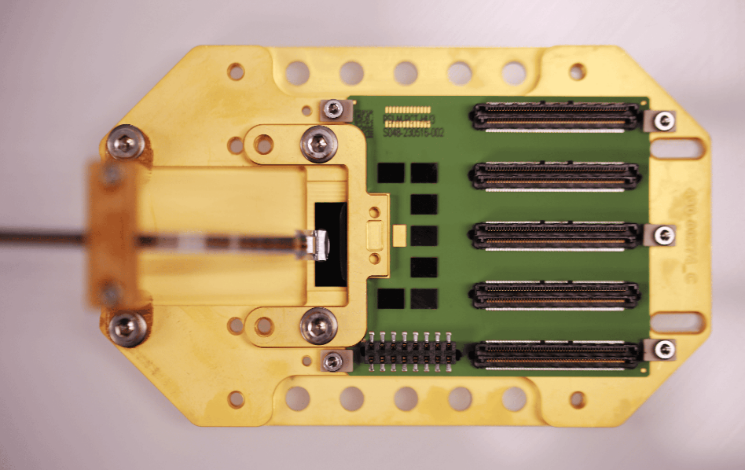
The second shows how the Qubit chip is mounted in a physical holder and interfaced with electronics.
PsiQuantum has a website dedicated to their development and publications. We encourage you to look at this site and if you wish to better understand their development and read their papers. I especially recommend two papers on error-correction and fault-tolerance found on the website. In addition, another paper on fault tolerance in fusion processing providing a stabilizer formalism to analyze fault tolerance and computations is also worthwhile. They have also presented a number of discussions on their development efforts that can be found here and here on YouTube. This video on YouTube discusses the progress in development of the quantum computers.
Conclusion
We will continue to track the error correction and fault tolerance efforts by the leaders in quantum computing development. As they begin to push the error rate down to parts in 106 to 1011, (1 in 1,000,000 (1 million) to 1 in 100,000,000,000 (100 billion)) to accomplish their goal we will start to see the development in breaking encryption systems and the other capabilities we discussed in our first quantum computing article. We will watch the battle between developers using trapped ions vs photonic qubits. We will also see who can move to the top and create a practical quantum computer.